
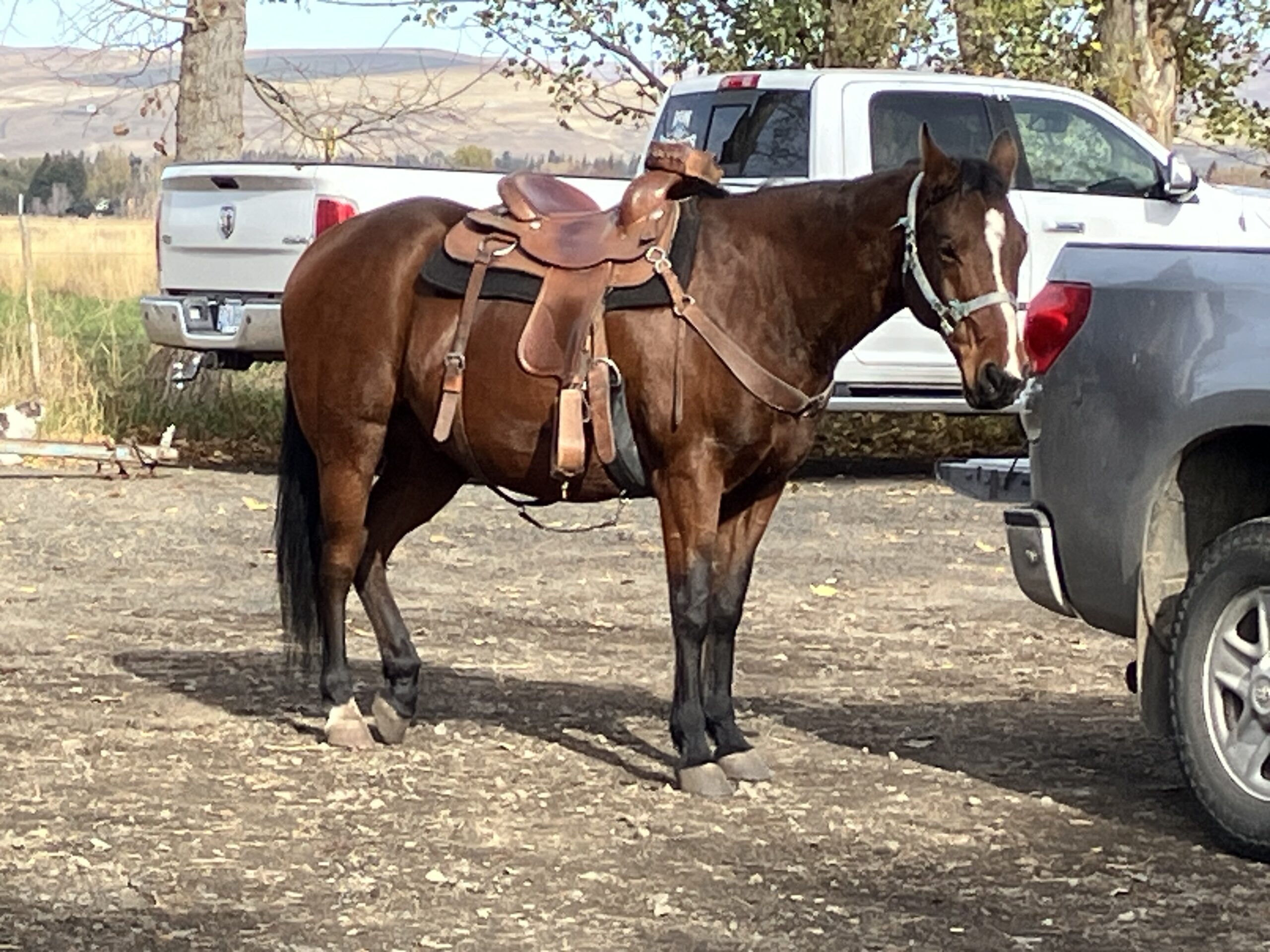
So far it’s been an open winter. We’ve had some snow, some frozen ground, but now things have warmed up a little bit, thanks to a series of storms brought in by an atmospheric river. We don’t get it nearly as bad here as the people on the West side of the Cascades will, but all the same…it should be snowing here, and it isn’t.
It’s somewhat of an adjustment to not be worrying about a hard-keeping horse in the winter after twenty years with a hard keeper. Even in an open winter like this, I had to keep an eye on Mocha to make sure she wasn’t losing weight, and she would have required a blanket or rain sheet on some of our stormy days so that she wasn’t burning calories keeping warm. But now, with Marker, it’s…simply not an issue. He went from a dry lot with hay nets (to keep him from wasting the hay. Boy is a very messy eater) to the big field and…has gained a little bit of weight. He’s back to the next-to-the last hole on his rear cinch, and even then it’s snug. Might have to punch another hole in it to fit.
But it feels weird to not be thinking about the blanket dance.
Marker had to take a little bit of a break because he strained a fetlock (we think) in his left hind. He recovered from that quickly. But I started poking around, and thought the root of the problem might be higher up, too, so I started putting liniment on his gaskins. Which he likes but…he also has shown a taste for the liniment itself. I discovered this the other day when he tongued open the cap and was licking the bottle. Spilled some today and he was licking it off of the truck tailgate. It has juniperberry oil in it so I suppose that’s what the attraction is.
In any case, we’re getting back into full work, riding in the field because it has the best footing. I haven’t been taking him on the roads because the type of storms we’ve been having reduces visibility, and even with a bright purple quartersheet I’m not sure we can always be seen. At least it’s not the driving, steady, pounding rain of Western Oregon. But intermittent showers can still leave me cold and wet at the end of a ride! Especially on a windy, blustery day.
On the other hand, it’s no worse and actually better than some of those stormy days I spent skiing at Timberline. I use the same type of base layers out riding that I used when skiing–synthetic, yes, with the ability to wick moisture away from my skin. In some cases, those base layers are the same ones I used in those ski days. Couple that with some of my old ski sweaters and an old hardshell parka, and it’s reasonably comfortable, even in the coldest weather. Oh, and insulated knee-high snow boots as well. I pushed wearing my regular boots as long as possible, then realized that I felt colder because wind could blow up the cuffs of my pants. Pulled on the insulated snow boots and did that ever make a difference.
The kind of riding I’m doing now has changed. Summer was a focus on schooling and refining skills–for both of us. I hadn’t realized until this summer just how much I had modified my riding to accommodate Mocha’s needs, then switched to young horse schooling with Marker. I’ve been doing light weight work to deal with tight back muscles, and that’s also helped as well. But I needed to work on bringing my legs back, which…those tight muscles had been impairing. One of those sneaky impairments that creeps up on you with age, I suppose.
In any case, Marker and I spent a lot of time in the arena this summer, and it’s pretty much paid off. He hits his canter leads darn near 99% of the time. He’s much more confident and strong when cantering, too. I’ve found that some horses really do just need to have a lot of time cantering to be strong enough under saddle to be relaxed about it, and given that a lot of gaited horses often struggle with cantering under saddle, we had to spend a bit of time conditioning. And it’s not consistent yet. I have a lovely, balanced, rocking-horse left lead canter. Right lead? He still wants to rush and speed up. More work and conditioning is required–rushing is a sign of tension. It’ll happen over time.
But winter work is different from the intensive schooling of summer. Oh, I do a little bit of schooling. Right now I’m working on developing seat cues, and he’s picking it up pretty well. We’re doing small serpentines and circles where the primary cues are the weight of the outside seatbone and the turn of my head, and that’s coming along nicely. It’s interesting, because Mocha was the cattier of the two horses–up to her last days, she was capable of executing a sharp 180 turn off of her haunches tighter and faster than most of the other horses (it was one of her evasions when another horse started making her move her feet). However, she wasn’t as responsive to seat cueing as Marker is so far–most of the time, I had to tune her up before I could casually weight a seatbone, turn my head, and have her respond. Marker? He has picked it up quickly. No tuning required. I can get that response with a weighted seatbone and head turn early in the ride, rather than later, after starting with heavier cues, then softening to the lighter cues. It’ll be interesting to see how light I can make him on a consistent basis.
I also invested in some inexpensive oversized stirrups because I didn’t like the way my regular stirrups work with the winter boots. Additionally, I had this sneaking hunch that they were making it more difficult to get on from the ground. Well, I’ve only had two sessions with the new stirrups but my theory has been confirmed–it is easier to get on with the oversized stirrups (just a hair wider), and they work a lot better with the winter boots. Plus they hang better from the fenders than the originals did. The biggest drawback is that they are plastic, so I wonder how durable they’ll be in cold weather. Oh well. Gives me data should I want to upgrade to more expensive ones.
But, mainly, winter riding is just more about keeping up the fitness for both of us. A slower, more relaxed riding time. A chance to work on our connection with each other. A throwback to the days of my youth, only with a better quality of horse.
If I had been told years ago that I would still be throwing a leg over the back of a good horse at age sixty-eight, I might not have believed it then. Now? Well, I’m gonna do my darnedest to keep going as long as I can.
And in order to do that, I need to drag my rear out to the field and ride the horse in all seasons.
